Email & CRM in 2026: Are You Ready?
09 Dec 2025
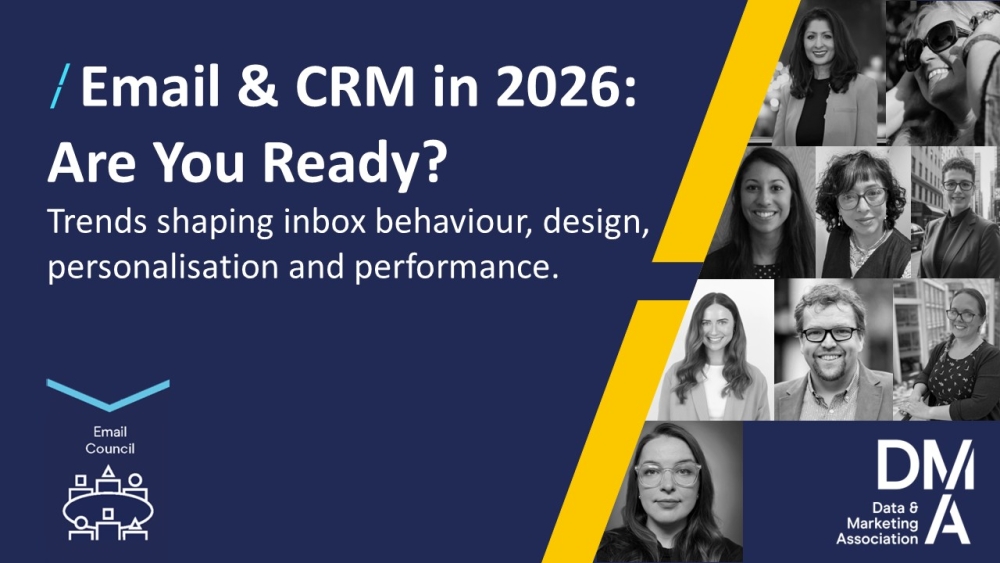
Contributors: Komal Helyer, Profusion; Chris Barnett, 1973 Ltd; Stephanie Black, British Airways; Susan Corless, TwentyCi; Sevil Crespo, VML; Bex Osborn, ActionRocket; Alex Ritchie, adm Indicia; Kristina Sallnow, Cancer Research UK; Sara Watts, DMRI; members of the Email Council.
.
During a recent DMA Email Council meeting, Chaired by Komal Helyer, members explored the major shifts that will shape email and CRM in 2026. The conversation focused on inbox behaviour, the growing influence of AI, changes to email design, and a shift in how performance is measured.
.
- A Move Away from Batch and Blast Campaigns
A strong theme in the discussion was the decline of traditional newsletter style campaigns. Members noted that brands are seeing reduced value from large, general email sends and are shifting towards always on, personalised and highly relevant messaging. Automated triggers, dynamic product catalogues and data driven personalisation are becoming more common as users expect tailored communication.
You should
- Review and reduce reliance on mass newsletters.
- Expand triggered journeys that react to user behaviour.
- Use dynamic content feeds to keep communications timely.
.
- AI Reading Email on Behalf of Users
The group discussed a major change already beginning to affect inbox behaviour. AI tools built into platforms such as Gmail and Outlook can summarise emails and surface key information without the user opening them. This means that a message can be consumed without generating a traditional open. Members believe this trend will accelerate as consumers grow more comfortable with AI integrating into inboxes.
You should
- Not rely on open rates for performance insight.
- Prioritise clear subject lines and pre headers that communicate meaning.
- Ensure emails contain accessible text that AI systems can summarise.
.
- The Impact of AI Driven Summaries on Engagement
With inboxes becoming increasingly crowded, the group noted that many consumers may start asking AI tools to highlight their most important messages. Although some members raised trust concerns, there was broad agreement that the convenience of AI assisted sorting will appeal to many users. This will make it even harder for non-essential messages to gain attention.
You should
- Place critical information at the top of emails.
- Keep layouts simple so AI summarisation tools reflect the intended message.
- Assume that many users may never fully open an email and design accordingly.
.
- Email Design Must Adapt to the AI Mediated Inbox
As inbox tools change how emails are previewed, email design patterns need to evolve. It was noted that features such as image carousels in the inbox allow content to be viewed without opening the email, reducing recorded opens. The group agreed that email structure will need to change to cater for both human readers and AI platforms which extract text and meaning from HTML.
You should
- Use more text-based structure and avoid over reliance on images.
- Check that HTML is clear and semantically logical for both humans and AI.
- Focus on clarity and accessibility to increase relevance in an AI summary.
.
- The Growth of Two-Way Email Experiences
One of the most innovative trends raised was the development of two-way email journeys using automated agents. Members discussed recent examples where recipients could reply to emails and receive instant, helpful responses about products, services or locations. These agent powered exchanges were described as potentially transformative for customer experience.
You should
- Experiment with reply enabled campaigns that provide conversational support.
- Use simple queries to begin with, such as product recommendations or store locations.
- Put safeguards in place to ensure accuracy and protect brand reputation.
.
- Measurement Is Evolving Beyond Opens
Members agreed that open rates have become unreliable. Auto opens, security scanning and AI summarisation all contribute to distorted results. The discussion highlighted a shift towards metrics that reflect genuine user engagement, such as click reach and conversion behaviour across journeys.
You should
- Review your reporting framework to reduce emphasis on opens.
- Track clicks, click reach and downstream behaviours instead.
- Implement more robust engagement segmentation to protect deliverability.
.
What This Means for 2026
The discussion made it clear that 2026 will be a year of significant adjustment for email and CRM teams. AI will influence how messages are read, sorted and interacted with, which means marketers will need to design content that works for both people and intelligent inbox tools. Personalisation will continue to expand, but the complexity of customer behaviour, channel noise and data ecosystems will also increase.
Measurement will evolve as open rates lose relevance and click focused engagement becomes more important. Meanwhile, new forms of two-way communication offer opportunities to shorten journeys and improve user experience.
To succeed in 2026, teams will need to focus on clarity, relevance, accessibility and smarter automation, supported by stronger skills and more adaptable processes.
If you would like to be involved in discussions like this, apply to join the Email Council, or get in contact with the Councils Team.
.
Learning Content on DMA Academy
DMA Corpoate Members have full access to all the learning materials on our Academy, including our Qualification in Email Marketing Strategy.
.
Email Marketing: Strategy and Tactics Masterclass
Next Date: 23/02/2026 - 24/02/2026
Master the end-to-end process of creating high-performing email campaigns. Across two days, email specialist Natalie Rockall will guide you through planning, testing, personalisation and optimisation techniques that drive stronger engagement and higher conversions. Build the confidence and capability to make every email count.
.
Copywriting for Web and Email Masterclass
Next Date: 03/02/2025
Craft compelling copy that grabs attention, builds trust, and drives action across your digital channels. Copywriting specialist Tim Tucker will guide you through the principles of writing clear, persuasive and customer-centred content for websites, landing pages and email campaigns.

Please login to comment.
Comments