Audience Planning: The Backbone of Modern Marketing
04 Nov 2025
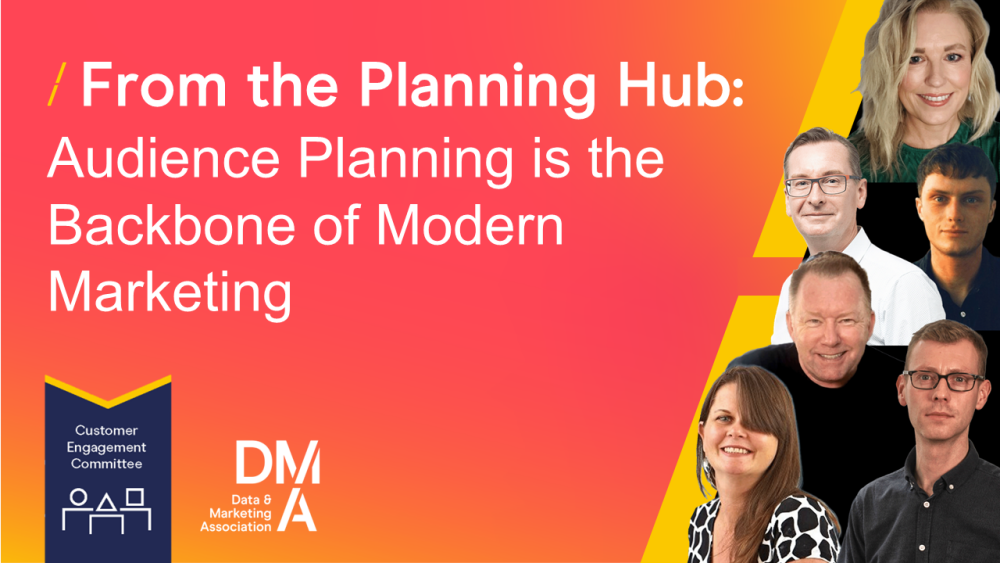
Marketers face more choices, tools and touchpoints than ever—but with that comes the risk of chaos.
Audience planning is how we bring focus, control, and commercial sense to an increasingly complex world. Done right, it should deliver the desired results like shooting fish in a barrel.
This new series of Planning Hub articles takes a forward-looking lens on human-led, AI-assisted planning. Derived from expert wisdom, we break down the core sections of planning, from audience strategy to measurement, to make them accessible to new audiences while reaffirming their importance for seasoned practitioners. The aim is to show that while AI offers powerful tools, it is human insight, empathy, and judgment that must remain at the heart of customer engagement.
The Stakes Are Higher, the Tools Sharper
The “spray and pray” tactics of the past are so ineffective at this point that they're reputationally risky. The sophistication of modern consumers, the explosion of channels, and the immediate availability of AI tools means even small brands can launch polished, data-driven campaigns overnight.
But the flip side of accessibility is confusion. Every inbox is flooded. Platforms are crowded. And touchpoints have multiplied to a point where a single campaign can fragment across 27 different routes to the same customer.
So, what’s the antidote? Rigorous audience planning. At its core, it’s about understanding customers first—then activating data, tech, and messaging with intention. It has been said a thousand times and more, but delivering the right message, to the right audience at the right time in the right way is, and always will be at the heart of successful marketing. The challenge now is to continue to do it in a changing technological environment and stand out from the crowd.
“Audience planning used to be for direct mail. Now it’s essential across the entire customer journey.”
– Adam Cochrane
Data Is Your Engine, You're Supposed to Drive
Most organisations have more data than they know what to do with. From demographics and behavioural signals to first-party purchase data and psychographic overlays, the challenge is no longer access—but clarity.
Great planning starts with asking: What are we trying to achieve? Then you work backwards. That’s where data dictionaries, ownership protocols, and shared standards come into play. Without these, data becomes a minefield of conflicting definitions and missed opportunities.
But it’s not just about quantity. Planners must balance strategic data (what people say and feel) with behavioural data (what they actually do). Over-relying on micro-segments or obsessing over weekly KPIs can cause teams to lose sight of brand storytelling and long-term impact.
“You need to trust your data but not worship it. It should guide, not dictate.”
– Louise Winch
Segmentation: Where Art Meets Architecture
It is widely recognised that businesses that use a one-size-fits-all approach do so at their peril. From attitudinal groups to transactional patterns, the smartest approaches tailor segment design to each objective—whether it's channel selection, product messaging, or retention planning.
And it goes beyond customer type. In B2B, there’s often more behavioural similarity between finance professionals across companies than between departments within one. Meanwhile in B2C, generational preferences (like Gen Z’s aversion to emails and phone calls) must shape contact strategy if you want the desired level of engagement and messages to land.
Segmentation should empower campaigns to respect the customer’s preferred channels and cadence—not just squeeze out short-term results.
“True segmentation respects the person, not just the profile.”
– Charlie Nock
Air Traffic Control: The Unsung Hero of Engagement
Here’s a truth we don’t talk about enough: great planning is knowing both what to send and what not to send. Contact fatigue is real, and too many brands are still guessing when it comes to frequency caps or prioritisation rules.
A simple contact policy—like two marketing emails per week—can help. But the real magic happens with intelligent orchestration. That means designing joined-up customer journeys, prioritising service messages over promotions, using tech to track overlaps, and aligning teams so that brand, product and legal campaigns aren’t all shouting at once.
This isn't just operational hygiene. It’s how you protect the value of your first-party data and the trust customers place in you.
“Without planning, marketing becomes noise. Air traffic control ensures your message actually lands.”
– Paula Byrne
AI Can Amplify, Not Replace, Human Planning
AI brings serious advantages to the table: predictive segmentation, next-best action modelling, dynamic creative, and real-time testing. And yes, it can shrink timelines from six weeks to six days. But let’s not forget: AI learns from us.
That’s why human oversight remains critical. Ethics, empathy, and creativity all shape how marketing feels. No one wants a future where every brand sounds like a ChatGPT clone. The goal is augmentation, not automation.
For junior planners, AI can act like a co-pilot: speeding up research, highlighting anomalies, and generating variations. But the responsibility to ask why—and to imagine what if—will always belong to humans.
“The danger isn’t AI replacing planners—it’s planners using AI without purpose.”
– Charlie Nock
The Future: Same Principles, New Possibilities
By 2030, audience planning might look flashier—AI-led segmentation, hyper-personalised journeys, even dynamic pricing based on real-time signals—but its essence won’t change.
Planning will still mean starting with customer understanding: Setting clear goals; Aligning stakeholders; Measuring what matters.
If you're mentoring the next generation of planners, there's one thing we want you to pass on: You’re not planning for data points, you’re planning for people.
Where Do We Go from Here?
Customer planning doesn’t need a rebrand. It needs recognition. As a career path. As a strategic function. As the thing that turns smart thinking into connected action.
The Customer Engagement Committee examines the interplay of creativity, data, and technology to explore loyalty and acquisition. They do so with research, events, and thought leadership. Apply to the councils here.
You can also join the waitlist for Customer Engagement 2025 where we address the questions of engagement, loyalty, retention, and customer win-back for the benefit of all UK marketers and consumers.
Please login to comment.
Comments